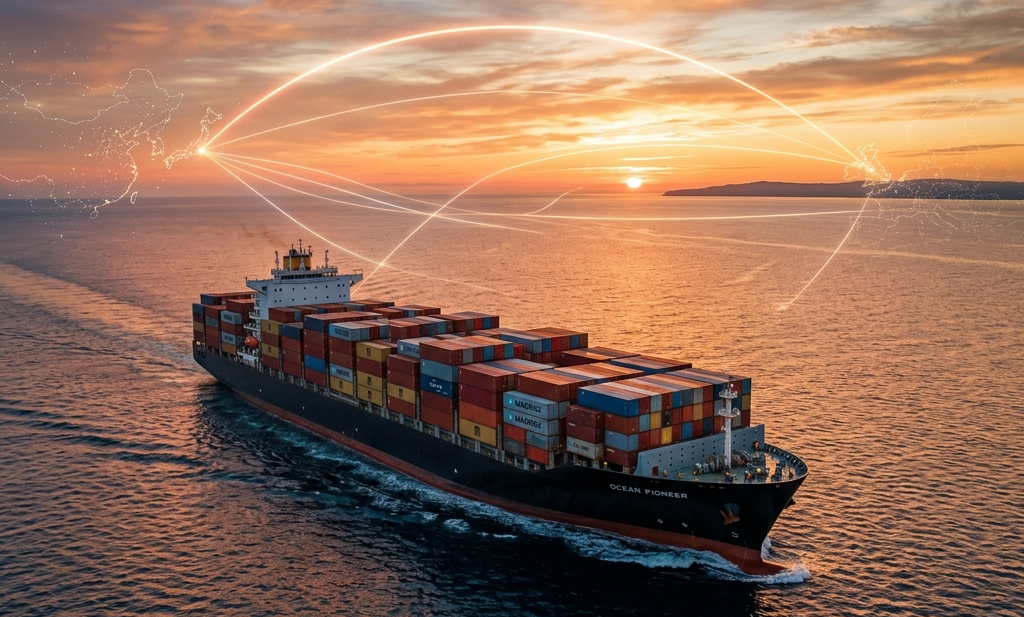
Shipping from China to the UK might take anywhere from a day or two to more than a month, depending on the service you choose. There is no one right answer because the best time varies based on your desired shipping method, where in China you pick up, where you are delivering to in the UK, how your goods clear customs, and the season you are shipping.
By providing you realistic time frames for every method and outlining the differences between them, this guide will help you decide which option truly matches your freight rather than just which is the fastest on paper.
Quick Answer: Shipping Times at a Glance
All figures below are transit times as quoted through our own booking system. Total delivery time is usually longer — see the next section.
| Method | Typical transit time | Best for |
|---|---|---|
| Air Freight (Express) | 1–2 days | Urgent, deadline-critical, or high-value shipments |
| Air Freight (Economy) | 2–3 days | Time-sensitive shipments where Express isn’t required |
| Road Freight | 15–25 days | Medium-volume shipments needing direct inland UK delivery |
| Rail Freight | 23–27 days | Balancing cost and speed on larger volumes |
| Sea Freight | 20–30 days | Bulk or lower-urgency cargo at the lowest cost |
Transit Time vs Total Delivery Time
First-time importers always come across a common point of confusion. That is the difference between transit time and delivery time. Transit time is the total time your goods spend travelling, whereas total delivery time – sometimes known as door-to-door time – includes collection from your supplier, export documentation, transit time, UK customs clearance, and final mile delivery to your address.
When it comes to air freight, the difference is particularly significant: a 1-2 day Express transit usually takes 3-5 days door-to-door, whereas a 2-3 day Economy transit usually takes 5-7 days. Since the voyage itself takes weeks, the additional handling time is less significant as a percentage on sea, rail, and road.
When making plans for a deadline, always consider the entire delivery time rather than just the transit time.
What Affects Shipping Time from China to the UK?
Quoted transit times assume a smooth journey. In practice, several variables can move the real timeframe.
Shipping method
The most important factor. Air moves in days, sea in weeks, with rail and road in between — covered in detail below.
Collection location in China
Shipping from a major hub like Shanghai, Shenzhen or Ningbo is typically faster and more predictable than collection from a less-connected inland city, simply due to freight frequency and route availability.
UK destination
Delivery to a major city is usually quicker and more predictable than delivery to a remote or rural address, where the final-mile leg takes longer.
Customs clearance
Goods can be held for review, or delayed by incomplete paperwork. Covered in full further down.
Time of year
Chinese New Year, usually in late January or February, is the biggest seasonal disruption, alongside UK and Chinese public holidays and the pre-Christmas peak — see our guide to Chinese New Year shipping delays.
Documentation
A missing commercial invoice, incorrect commodity code, or absent EORI number will hold a shipment at UK customs until resolved, regardless of how fast the transit itself was.
China to UK Shipping Time by Method
A closer look at each method — what it suits, and where it doesn’t make sense.
Air Freight
Air freight consists of two tiers. Express takes 1–2 days in transit (typically 3–5 days door-to-door) and suits urgent or deadline-critical shipments. Economy takes 2–3 days in transit (typically 5–7 days door-to-door) and suits shipments that are time-sensitive but not on a hard deadline. Air freight costs more per kilogram than any other method — the trade-off is speed, not price.
Read more: air freight from China to the UK
Rail Freight
Rail freight typically takes 23–27 days door-to-door. The journey runs in two legs — by rail from China through Central Asia into mainland Europe, then an onward leg into the UK — rather than a single unbroken line. Rail sits between air and sea: cheaper than air, and more predictable than sea, with the added benefit of reaching inland UK destinations directly.
Read more: rail freight from China to the UK
Sea Freight
Sea freight typically takes 20–30 days, and is the cost-effective alternative that is based on per unit of cargo — the trade-off is the longest transit time of any method. It suits bulk shipments or cargo that isn’t time-critical. Shipment size also affects the specific service used: LCL (Less than Container Load), where cargo shares space with other shipments, or FCL (Full Container Load), for larger volumes.
Read more: sea freight from China to the UK
Road Freight
Road freight typically takes 15–25 days. It sits between rail and sea on time, and offers one practical advantage over both: direct delivery to inland UK locations, without the port-to-warehouse leg that sea freight requires. It suits medium-volume shipments — larger than a small parcel, not yet at container-load scale.
Read more: road freight from China to the UK
How to Choose the Right Shipping Method
The right method depends on your situation, not a fixed rule. A few questions worth asking yourself:
How urgent is the shipment?
A launch date or an unforeseen stock shortage are examples of strict deadlines that point to Air Express. Without the premium of air freight, rail or road freight offers you a significantly lower cost per kilogram if you have a few weeks to spare.
How large is the shipment?
Small to medium shipments suit air or road well. Larger volumes shift the economics toward sea or rail, where cost per unit drops significantly as volume increases.
What’s the value of the goods?
Since the cost of the goods while they are in route (as well as the possibility of a missed sales window) exceeds the additional freight cost, higher-value commodities can frequently justify the expense of air freight. It is rarely justified by lower-value bulk goods.
Is this a one-off shipment or regular importing?
Regular importers often split their volume — air for anything urgent, sea or rail for standing stock — rather than using one method for everything.
As a rough guide: need it as fast as possible → Air. Want a balance of speed and cost, with inland delivery → Road or Rail. Moving larger volumes and time isn’t critical → Sea.
Not sure which option fits your shipment? Compare live rates across all four methods. Get an instant quote
Customs: How Much Time Should You Allow?
Shipping time and delivery time aren’t the same thing, and customs clearance is the main reason why. Once goods arrive in the UK, they go through import clearance — checking documentation and confirming the commodity code and declared value. What you’ll pay in duty and VAT is covered in our guide to import tax from China to the UK.
Clearance is usually fast when documentation is complete and accurate. It can take considerably longer if a shipment is selected for inspection, or if paperwork is missing or incorrect. There’s no fixed guaranteed clearance time — it should be planned for, not assumed away.
Door-to-Door vs Port-to-Port
When someone searches for “shipping time,” they often mean “how long until my goods reach my warehouse” rather than just the duration of the ship’s or flight’s journey. Only the primary transit leg is covered under port-to-port (or airport-to-airport). Door-to-door shipping includes collection from your point of origin, the entire trip, clearance via UK customs, and final delivery to your address.
Transit times are shown by the numbers in the above table. When planning against an actual deadline, always factor in collection and clearance time.
What If My Shipment Is Delayed?
Delays arise even with meticulous planning. Typical reasons include:
- A question about customs or an issue involving documents that must be clarified
- The shipment that will be physically examined
- Congestion at ports or airports, particularly during the busiest times of year
- Modifications to the carrier’s schedule
- Disturbances during public holidays in the UK or Chinese New Year
- Incorrect or insufficient consignee details
When you contact your forwarder, the most efficient way to find out if your cargo is delayed is to have your booking reference, shipment tracking number, and any customs correspondence ready. This will allow them to investigate the issue right away rather than having to follow up on the basic data first.
Track your shipment or get in touch if something looks delayed. Track your shipment
FAQ
How long does shipping from China to the UK take?
Varies based on the method. Air freight takes 1–3 days in transit, road freight 15–25 days, rail freight 23–27 days, and sea freight 20–30 days. Door-to-door timing piles on collection and customs clearance on top of these figures.
What is the fastest way to ship from China to the UK?
Air Express, at 1–2 days in transit and typically 3–5 days door-to-door. It’s also the most expensive method per kilogram.
How long does sea freight from China to the UK take?
Typically 20–30 days in transit, making it the slowest method but generally the most cost-effective per unit of cargo.
How long does customs clearance take in the UK?
There’s no fixed time. Clearance is usually quick when documentation is complete and accurate but may take significantly longer if a shipment is selected for inspection or the required paperwork is missing.
Does Chinese New Year affect shipping times?
Yes — it’s the biggest seasonal disruption of the year. See our guide to Chinese New Year shipping delays for dates and how to plan around it.
Can I get door-to-door shipping from China to the UK?
Yes — Factory2Door manages collection, freight, customs clearance and final UK delivery as one service, across air, sea, rail and road.
Get a Shipping Quote from China to the UK
Compare live rates and transit times across air, sea, rail and road — tell us your goods, weight and destination, and we’ll help you find the right fit.